How do you translate climate risk from reports and analyses into concrete actions in operations?

Published
Subject
Knowledge
Data alone protects no buildings. Action does.
At Upsite, we experience that many property owners and managers now have a solid grasp on their climate data. Screenings have been done, reports have been written, and the risk profile has been mapped. This is a good starting point.
But data alone protects no buildings. Action does.
At the same time, climate risk is moving from being a pure ESG matter to also becoming a financial parameter. Banks and insurance companies are increasingly demanding documented climate resilience, and with the EU Taxonomy and CSRD, it is eventually no longer something you can opt in or out of.
The question is therefore no longer whether to work with climate risk. It is how you actually get from report to action, without it taking weeks, requiring a team of specialists, or ending up as yet another document in the folder.
This is the question we at Upsite built the climate resilience module to answer. Here is how we approach it:
Climate risk screening: from the entire portfolio to the right priorities
The first step is knowing where the risk is actually greatest.
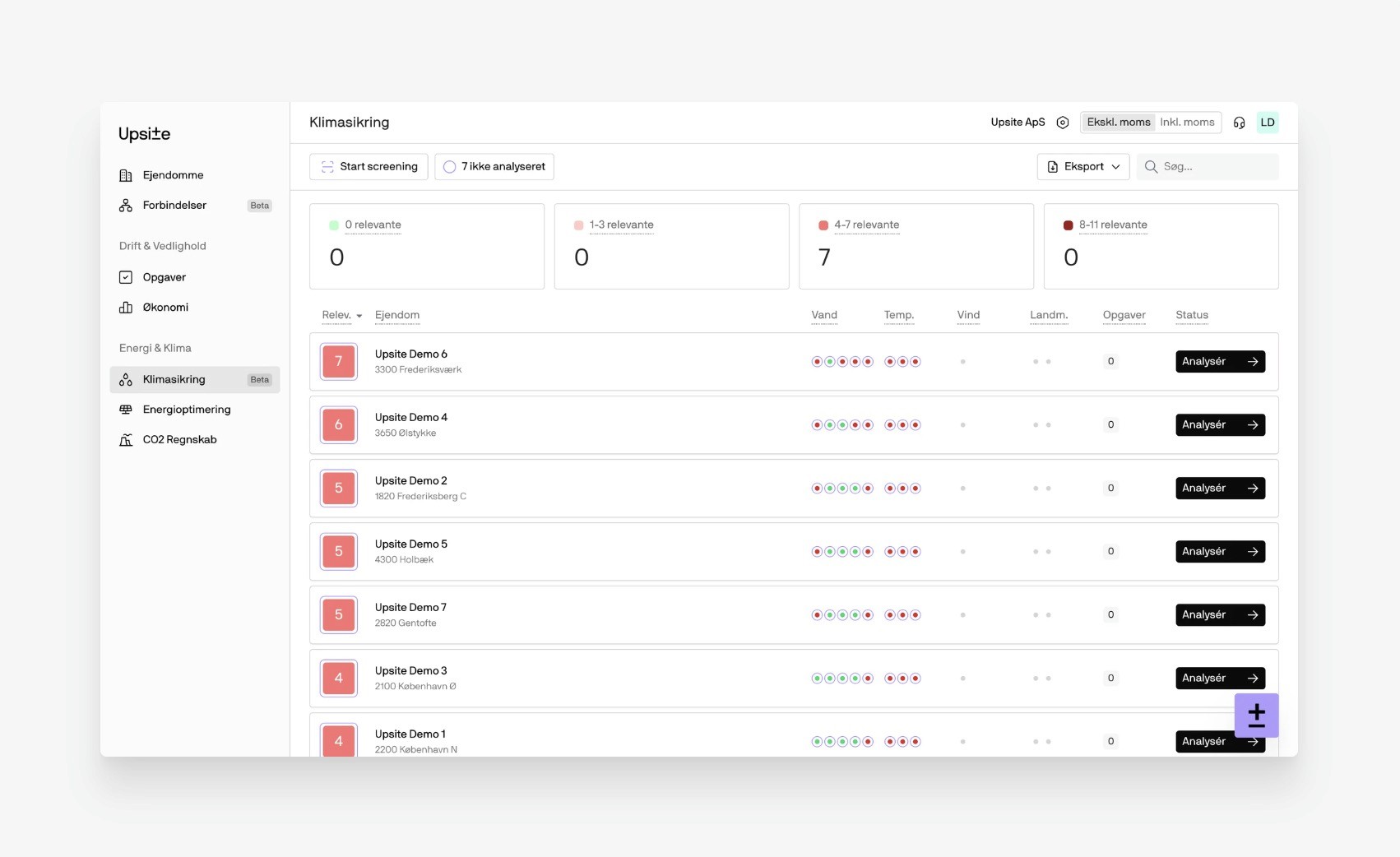
Do you have 20 properties in your portfolio? Or 200? With our portfolio screening, you get a comprehensive overview of climate risks across the entire portfolio, regardless of how many properties it consists of.
The platform automatically retrieves data from national sources, including the Climate Data Agency, the Geodata Agency, GeoDanmark, BBR, and the Valuation Agency, and aggregates them into a single risk profile. You can immediately see which properties are exposed, to what degree, and on which parameters.
This provides a solid foundation for prioritizing which properties require closer analysis, and for documenting the risk profile to management, investors, banks, and insurance companies.
The overview is not only relevant for property owners themselves. It is also a valuable tool for advisors, lenders, and others who need to assess climate risk across portfolios.
We believe that the first step towards a more climate-resilient portfolio should not take weeks or months. It should take seconds.
Property-level climate risk analysis: from prioritization to deep insight
The screening tells you where the risk is. The analysis tells you how severe it is and what you should do about it.
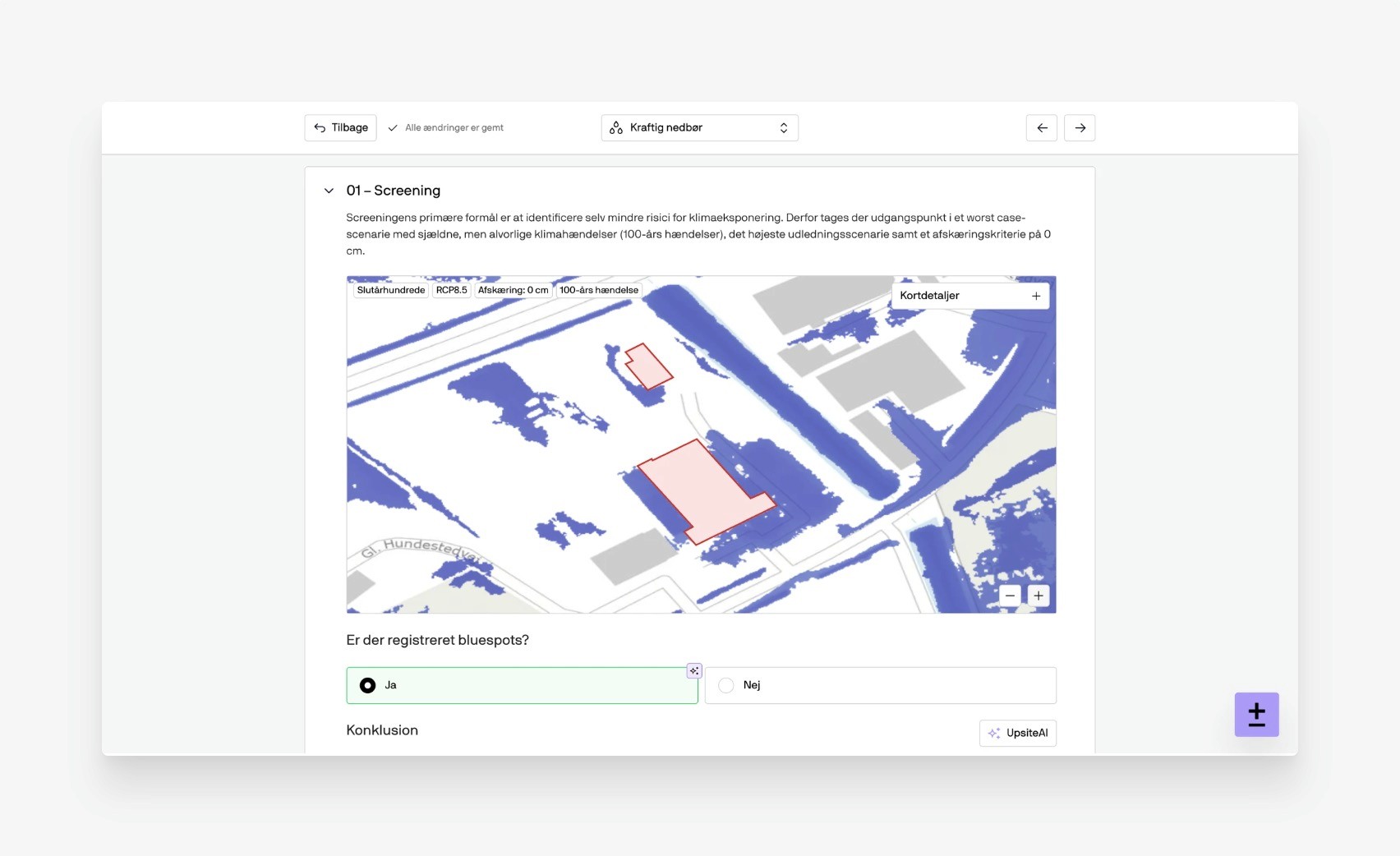
With Upsite, you can prepare complete climate risk analyses at the property level, guided step-by-step through the entire process. The platform automatically retrieves data from national sources and identifies the climate exposures relevant to the individual property. We then guide you through the analysis with data, professional guidance, and documentation, so you don't have to start from scratch every time or worry about overlooking an important step.
But technology only creates the structure. It is your knowledge of the property that qualifies the analysis.
Have you already climate-adapted the building? Are critical installations located in the basement? Or are there local conditions that affect the risk profile? Public data does not have this kind of knowledge, but you do. And it is your professional assessment that ultimately makes the analysis accurate.
All assessments, inclusions, and exclusions are documented ongoingly, so the analysis becomes consistent, traceable, and ready for reporting to management, investors, banks, insurance companies, and in ESG reporting, regardless of who in the organization prepared it.
Climate adaptation in practice: from analysis to operational tasks
A climate risk analysis that ends up as a document on the shelf protects no properties.
This is where we believe many tools on the market stop, and where the gap between risk and resilience truly arises. You have the analysis, but you don't have a system that translates it into something operations can actually act on.
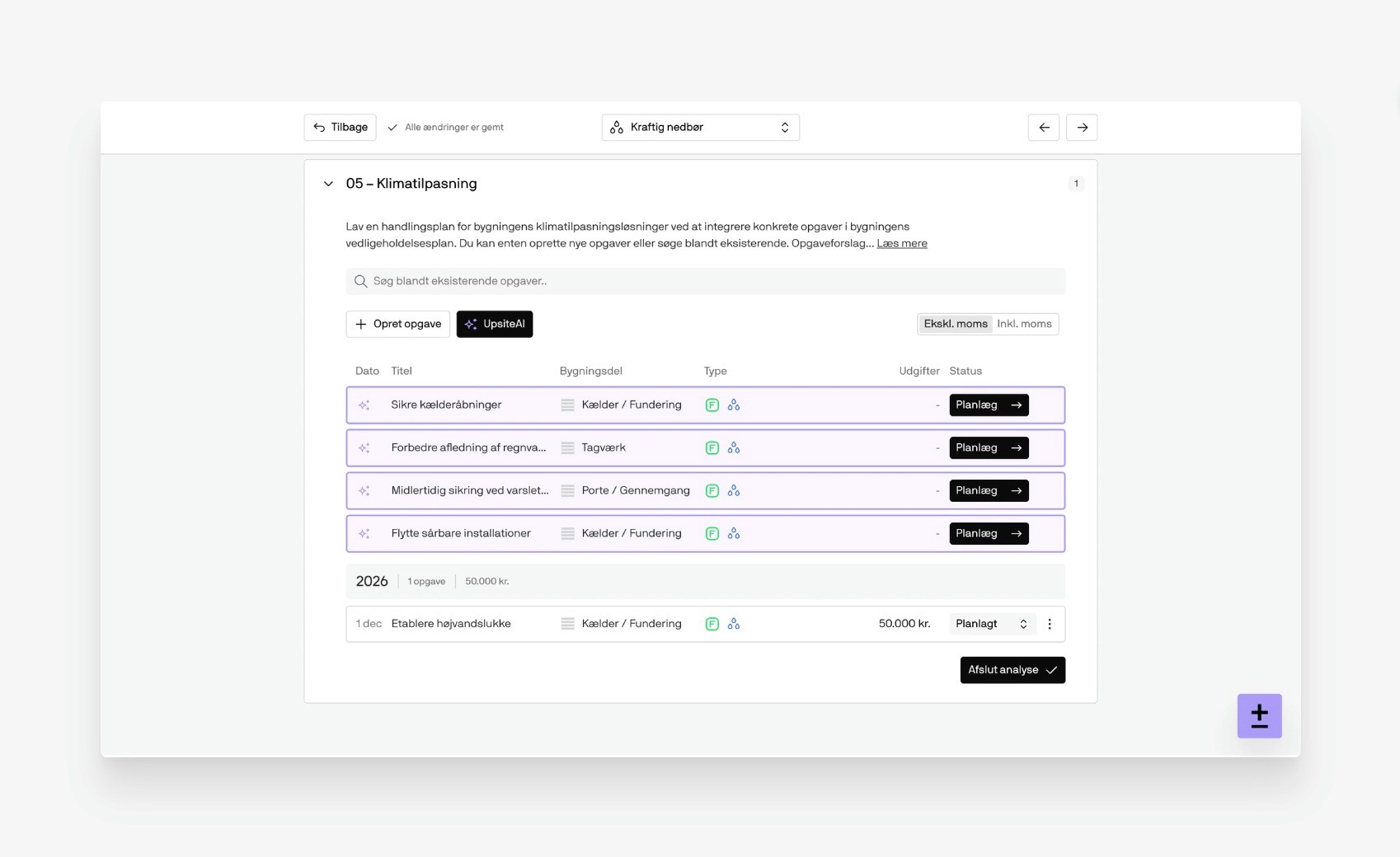
This is the gap we built Upsite to close. Climate adaptation measures are converted into concrete tasks directly in the maintenance plan, with just a few clicks. The tasks are assigned ownership, followed up on, and become an integrated part of daily property operations, in line with all other operations and maintenance.
This means you can pull data for compliance, insurance dialogue, or reporting at any time. Not because it was written down once, but because it lives in daily operations.
Checklist: is your climate data ready for banks, insurance, and CSRD?
No matter how far along you are in the process, it might be worth asking yourself a few simple questions:
Have you screened the entire portfolio for concrete, local risks such as cloudbursts, storm surges, and rising groundwater?
Do you know the most critical risks, and do you know where to prioritize efforts first?
Is climate risk integrated into ongoing operations and long-term maintenance plans, or does it still reside in a report?
Do your systems deliver the documentation required by CSRD and the EU Taxonomy?
Do you have a plan to protect residents and indoor climate against consequential damage such as damp and mold?
If you can answer yes to most of these, you are already well on your way. If you cannot, you are far from alone, but that is also where the gap between risk and resilience arises for most property owners.
We believe that climate adaptation is not an expense you can avoid. You can only choose when to take it.
And for us, the choice is not about whether to act. It is about acting now while it is a decision, rather than later when it is a necessity.